Learn why food freezes in your refrigerator crisper drawer, what to check first, and when West Michigan homeowners should call HomeHalo.
If your refrigerator is freezing food in the crisper drawer, the most common causes are blocked airflow, a drawer humidity control left open, food packed too close to a cold-air path, a temperature setting that is too low, or a damper/sensor problem sending too much cold air into the fresh food section. In Grand Rapids, Kalamazoo, Lansing, and across West Michigan, this often shows up in late spring and summer when refrigerators run harder and families load the fridge with more produce, drinks, and leftovers.
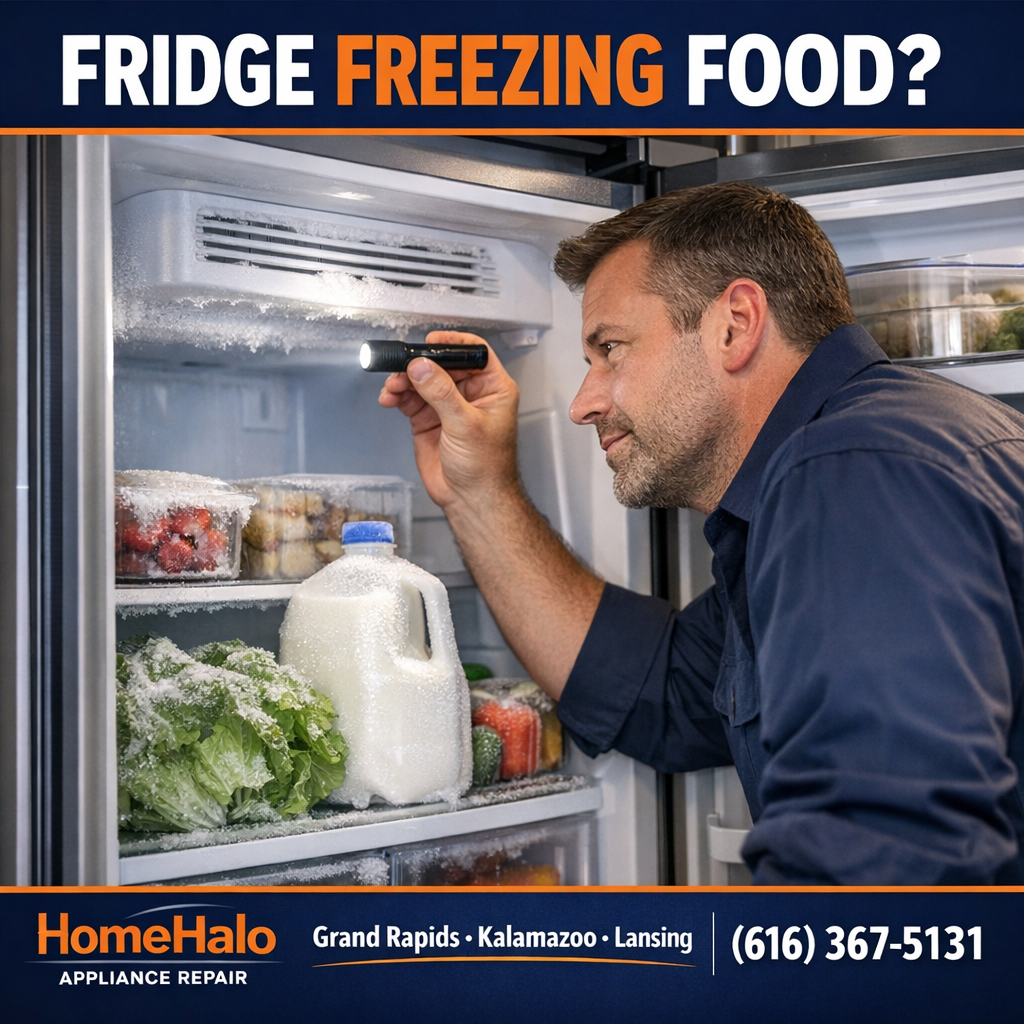
The good news is that crisper-drawer freezing is not always a major repair. Sometimes it is a loading or airflow problem you can correct in a few minutes. But if lettuce, berries, cucumbers, eggs, or deli meat keep freezing after you adjust the settings, the refrigerator may need a professional diagnosis before the problem turns into food waste, unstable cooling, or compressor strain.
What temperature should a refrigerator be set to?
For most homes, the fresh food section should stay around 37 degrees Fahrenheit. The freezer should stay close to 0 degrees. If your refrigerator compartment drops below 32 degrees, water inside produce, drinks, and dairy will start to freeze.
Do not rely only on the number shown on the refrigerator control panel. Many controls show a setting level, not the real temperature inside the cabinet. The most reliable first step is to place an inexpensive appliance thermometer in the middle shelf area and check it after several hours.
If the thermometer reads below 34 degrees, move the control one step warmer and give the refrigerator 24 hours to stabilize. Refrigerators do not respond instantly. Opening the door repeatedly while testing can also make the readings jump around.
Why the crisper drawer freezes first
Cold air usually enters the fresh food section through vents at the back or upper side of the compartment. Depending on the model, that cold air can move down toward the lower shelves and crisper drawers. If produce sits directly in that path, it can freeze even while the rest of the refrigerator is at a normal temperature.
This is especially common in side-by-side and French door refrigerators. The shelves look spacious, but the cold-air path is concentrated in specific zones.
Before assuming a part has failed, move sensitive foods away from the rear wall and vents. Place drinks and condiments near the door, keep produce loose in the drawer, and leave a few inches of open space where cold air enters the refrigerator.
Blocked vents can create cold crisper zones
Refrigerators need steady airflow to balance temperature. When food containers block the vents, cold air can pool in one section instead of circulating evenly. That creates frozen spots in one area and warmer spots somewhere else.
Look for these signs:
- Lettuce freezes in the crisper, but door items feel barely cold
- Produce freezes near the back of the drawer but not near the front
- The refrigerator runs often but still feels uneven
- Frost appears around interior vents
- Food packages are pressed tightly against the rear wall
The crisper humidity slider may be open
Many crisper drawers have a humidity slider. On some models, moving the slider opens a small vent. That can help high-moisture produce breathe, but it can also let colder air pass through the drawer area.
If delicate produce is freezing, move the slider toward the closed or high-humidity setting and give the refrigerator a day to stabilize.
A stuck damper can send too much freezer air into the fridge
Many refrigerators cool the fresh food section by moving air from the freezer through a damper. Think of the damper as a small door that opens and closes to control how much cold air enters the refrigerator compartment.
A stuck damper can happen because of ice buildup, a failed motor, a broken linkage, or a control issue. If the refrigerator keeps freezing food after normal setting and loading changes, the damper is one of the first parts a technician should check.
The temperature sensor may be reading wrong
Modern refrigerators use thermistors or temperature sensors to tell the control board how cold the compartment is. If the sensor reads warmer than reality, the refrigerator keeps cooling even after the food section is already cold enough. The result is frozen food, long run times, and unstable temperatures.
Sensor failures are not always obvious from a visual inspection. A technician typically checks resistance readings, wiring, and the service diagnostics for that model.
Door gasket problems can still cause freezing
Most people associate bad door gaskets with a warm refrigerator. That is often true, but gasket problems can also contribute to freezing in certain areas. If warm, humid kitchen air leaks into the cabinet, the refrigerator may run longer than normal to recover. That extended run time can overcool items near the air outlet.
Check the door gasket for food residue, tears, loose corners, or areas that do not seal flat against the frame. Wipe the gasket with warm soapy water, then dry it completely. Close the door on a dollar bill or sheet of paper in several places. If the paper slides out with almost no resistance, that section may not be sealing well.
May and summer loading can make the problem worse
Late spring changes how families use refrigerators. Kids are home more often, drinks get loaded in bulk, produce drawers fill up, and the door opens constantly during warmer weather. A refrigerator that was barely managing airflow in March may start freezing food in May or June because the usage pattern changed.
Grand Rapids, Kalamazoo, and Lansing homeowners also deal with humid weather. Moist air entering the refrigerator can create frost around vents, especially if the door is opened often or a gasket is weak. That frost can interfere with airflow and make cold spots worse.
If freezing started after a large grocery run, graduation weekend, or cookout prep, reorganize first. If it continues for several days after the load returns to normal, it is time to look deeper.
What you can check before calling for repair
Start with the low-risk checks:
- Put an appliance thermometer in the fresh food section and verify the real temperature
- Set the refrigerator around 37 degrees and the freezer around 0 degrees
- Move food away from rear walls and cold-air vents
- Avoid overpacking shelves and crisper drawers
- Move the crisper humidity slider toward the closed/high-humidity setting
- Clean and inspect the door gasket
- Make sure the refrigerator doors close completely
- Check whether freezing is isolated to one shelf or happening everywhere
- Listen for fans running constantly or unusual clicking
Give the refrigerator 24 hours after any setting change. If you make several changes at once, write them down so you know what helped.
When crisper freezing points to a repair
Call for refrigerator repair if food keeps freezing after you have confirmed the settings, cleared vents, and reorganized the shelves. Also call if the refrigerator temperature swings from too cold to too warm, if frost is building around vents, if the fan sounds loud or inconsistent, or if the freezer is normal while the fresh food section keeps overcooling.
The likely repair depends on the model and symptoms. Common causes include a failed thermistor, stuck air damper, faulty control board, bad door gasket, fan issue, or defrost-related airflow restriction. A good diagnosis matters because these problems can mimic each other.
If you are comparing this issue with other refrigerator symptoms, these HomeHalo guides may help:
- Why is my refrigerator freezing food on the lowest setting?
- Why is my refrigerator warm but freezer cold?
- Why is there ice building up in my freezer?
- Why is my refrigerator not keeping food cold?
How HomeHalo diagnoses refrigerator freezing problems
HomeHalo Appliance Repair serves Grand Rapids, Kalamazoo, Lansing, and the surrounding West Michigan area. For refrigerator crisper-freezing complaints, we verify actual temperatures, inspect airflow, check door sealing, evaluate the damper and sensors, and identify whether the issue is a simple adjustment or a failing part.
HomeHalo’s diagnostic visit is $179 and applies toward the repair when appropriate. That gives you a clear answer before parts are replaced, which matters with refrigerators because several different failures can produce the same frozen-food symptom.
If your refrigerator is freezing food and the simple checks above do not solve it, call HomeHalo Appliance Repair at (616) 367-5131 or request service through our verified contact page: https://homehalorepair.com/contact/.
Need appliance repair in West Michigan?
Same-day service available. Honest pricing. nearly 600 five-star reviews.
Exact-match city pages for this repair search
If you are looking for service instead of general troubleshooting, these city pages are the fastest route into the main money-page clusters and local service-area hubs.
When to Call a Professional
- → The appliance makes burning, sparking, or unusual electrical smells
- → DIY troubleshooting hasn't resolved the issue after one attempt
- → The repair involves gas lines, electrical components, or sealed refrigerant systems
- → The appliance is still under warranty (DIY may void it)
HomeHalo serves Grand Rapids, Lansing, Kalamazoo & West Michigan. (616) 367-5131
💡 Key Takeaway
When in doubt, a professional diagnosis costs less than guessing wrong. HomeHalo provides free estimates and upfront quotes, you'll know the cost before any work begins. Call (616) 367-5131 for same-day service across West Michigan.